


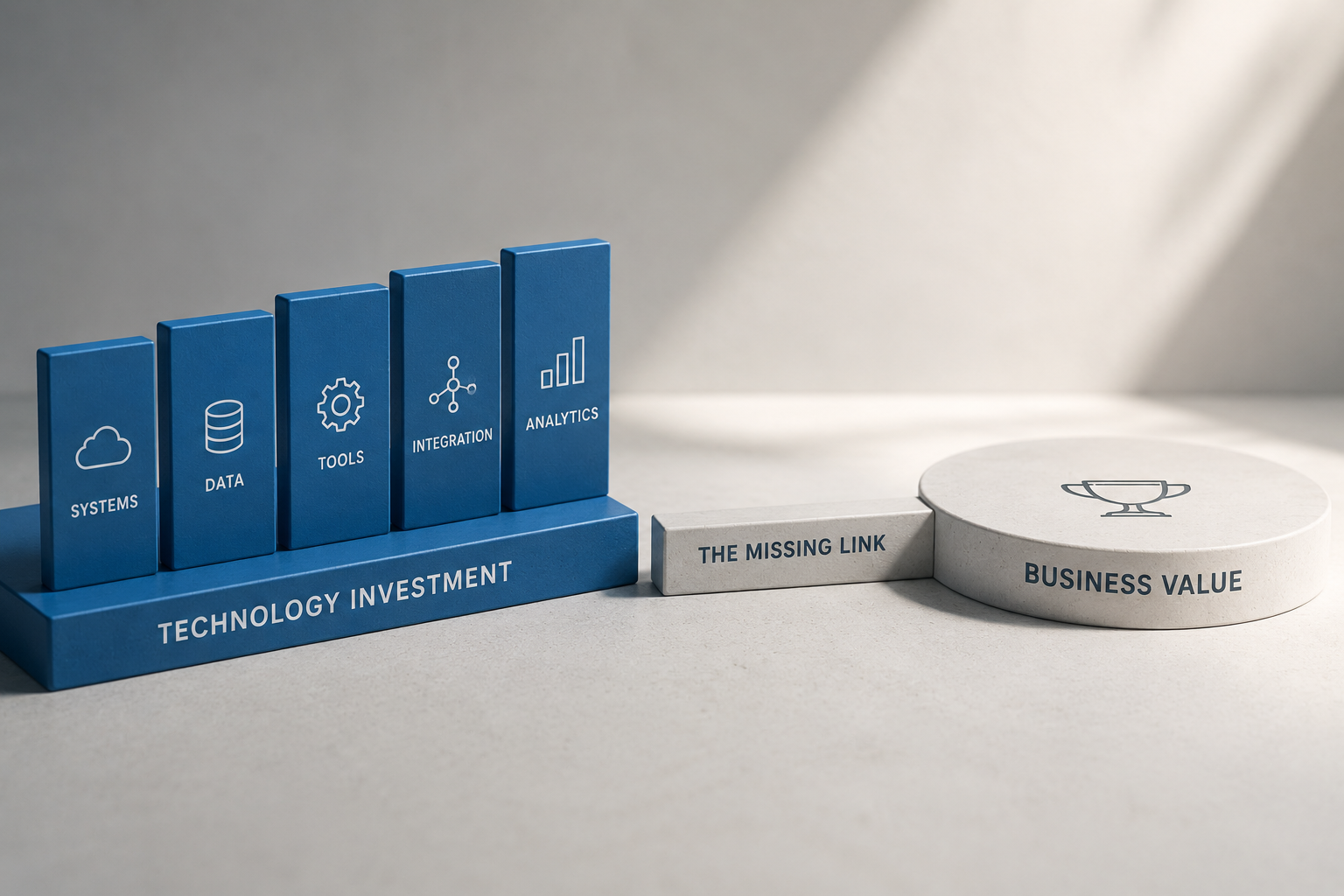
Modern organisations depend on reliable data infrastructure and core systems. These foundations are essential. The problem arises when the adoption of a new system, platform or analytical tool is treated as equivalent to the creation of value.
Technology provides potential. Capability converts that potential into a repeatable business outcome.
A sophisticated platform can process more data, automate more tasks and present more information. It does not, by itself, determine which decision matters, how the organisation should respond, which trade-offs are acceptable or whether the resulting action creates economic value.
Technology investments often underperform for reasons that sit outside the technology itself.
The first is an unclear business purpose. The organisation may define a broad ambition such as “become data-driven” or “use AI”, but not the decisions, processes or outcomes the investment must improve.
The second is feature-led selection. Teams compare functionality, architecture and automation while giving less attention to the practical context in which the tool must operate. The organisation then adapts itself to the product rather than applying the product to a clearly defined need.
The third is fragmented ownership. IT may be accountable for implementation, a function may own adoption and leadership may expect commercial value, but no one is accountable for connecting all three.
The fourth is capability scarcity. The tool exists, but the organisation lacks the multidisciplinary skills needed to interpret outputs, connect them to financial consequences and embed them in decision-making.
The fifth is delayed relevance. Large implementations can take long enough for the original market conditions, priorities or requirements to change before value is realised.
Adoption measures whether a tool has been implemented and used. Application measures whether it has been used well enough to change an outcome.
A dashboard can be adopted widely while decisions continue to rely on instinct. An AI capability can automate commentary while the underlying measures remain disconnected from strategy. A planning system can standardise forecasts while the assumptions and trade-offs that matter most remain hidden.
Application requires the tool to be embedded in a broader process: the right question, the right data, the right commercial logic, the right judgement and a clear mechanism for action.
A useful way to evaluate technology value is to consider the full capability stack.
At the top is the decision or business outcome. What must improve, and how will success be recognised?
Below that is strategic and commercial context. Which customers, products, markets, resources and trade-offs shape the outcome?
Next are people and processes. Who interprets the information, who makes the decision, how often does the process occur and how is action followed through?
Then comes data and analytical logic. Which sources, assumptions, models and measures create a reliable view?
Technology sits within this stack as the enabler that improves speed, scale, consistency or accessibility.
Finally, measurement closes the loop. Did the investment improve the decision, reduce risk, create value or change behaviour?
If any layer is missing, the technology may operate correctly while the business outcome remains unchanged.
Off-the-shelf solutions are designed to serve many organisations. That scale can make them powerful and cost-effective, but it also means the default configuration may not reflect a specific business model, decision process or source of value.
Organisations then face a choice: accept a generic application, customise the tool extensively or change internal processes to fit it. Each option has consequences. Generic use may capture only a fraction of the potential. Customisation can create cost and complexity. Process change can be disruptive and may weaken practices that were commercially important.
The right answer varies, but the decision should begin with what the organisation needs to achieve rather than what the product is capable of doing.
Build, buy, augment or partner?
Technology and analytical capability do not have to be sourced through a single model.
Building internally can be appropriate when the capability is strategically distinctive, frequently used and supported by sufficient scale. Buying a platform can be effective when requirements are standard and the organisation has the skills to apply it. Augmenting an internal team can close a specific expertise or capacity gap. Partnering can provide rapid access to a proven multidisciplinary capability while the organisation learns what good looks like.
The choice should reflect urgency, strategic importance, internal maturity, total cost, adaptability and the level of accountability required for outcomes. It should not be driven only by a preference for ownership or a desire to acquire the newest tool.
Before approving a material technology or analytics investment, leadership should ask:
These questions shift the discussion from purchasing technology to engineering value.
A lower-risk approach is to begin with a clearly scoped decision or challenge. Use the current data and systems where possible, augment them only where needed and establish the commercial logic before committing to a larger platform or transformation.
This can generate near-term value while also producing a practical blueprint for future capability. Leadership gains evidence about what is useful, which data matters, how the process should work and where technology can genuinely improve the outcome.
Technology can materially improve business performance, but only when it is applied within a capability that connects strategy, finance, operations, data and human judgement.
Enlite works with leadership teams to define the decision first, make the value pathway visible and use technology in service of the outcome rather than as the outcome itself.

.svg)
.svg)