


For many leadership teams, the frustration is not that the organisation lacks capability. Quite the opposite. Finance understands the numbers. Analysts know the data. Commercial teams understand customers and markets. Operations understands what can be delivered. Technology has improved. Reporting is faster. Strategy is discussed seriously.
And yet, when an important decision reaches the leadership table, it can still feel harder than it should.
A market looks attractive, but the economics are not fully connected. A product is growing, but the wider portfolio implications are unclear. A new channel appears promising, but its effect on customers, cost and capacity is debated. A strategic initiative has support, but finance, operations and data are still telling different parts of the story.
If that feels familiar, we understand the frustration. It is one of the reasons Enlite exists.
Most business functions are designed to do their own jobs well. That specialisation is valuable. The challenge is that consequential decisions rarely belong neatly to one function.
Each view may be sound. The problem appears at the point leadership needs one answer. Someone still has to reconcile the evidence, the economics, the operational reality, the alternatives and the likely future consequences into a coherent basis for action.
The organisation may therefore have all the ingredients and still be missing the connection between them.
Enlite was not conceived from the belief that organisations needed another dashboard, another platform or another disconnected layer of analysis. It came from experiencing the problem from the other side of the table.
We had seen capable organisations invest in finance, technology, analytics and strategic planning, yet still struggle to bring those capabilities together quickly enough and commercially enough around the decisions that mattered most. The amount of information available had increased dramatically. The ability to turn it into an integrated view of what to do next had not always kept pace.
The issue was rarely that one critical ingredient was entirely absent. Something was missing between the ingredients.
That gap became the idea behind Enlite: create a capability that sits where strategy, commercial finance, operations and data meet, and organise those disciplines around the decision rather than around the function.
When decision support underwhelms, the instinct can be to add something else: another system, another dashboard, another specialist, another planning layer or another transformation programme.
Sometimes those investments are necessary. But sometimes the bigger opportunity is not another ingredient. It is making the existing ingredients work together more effectively.
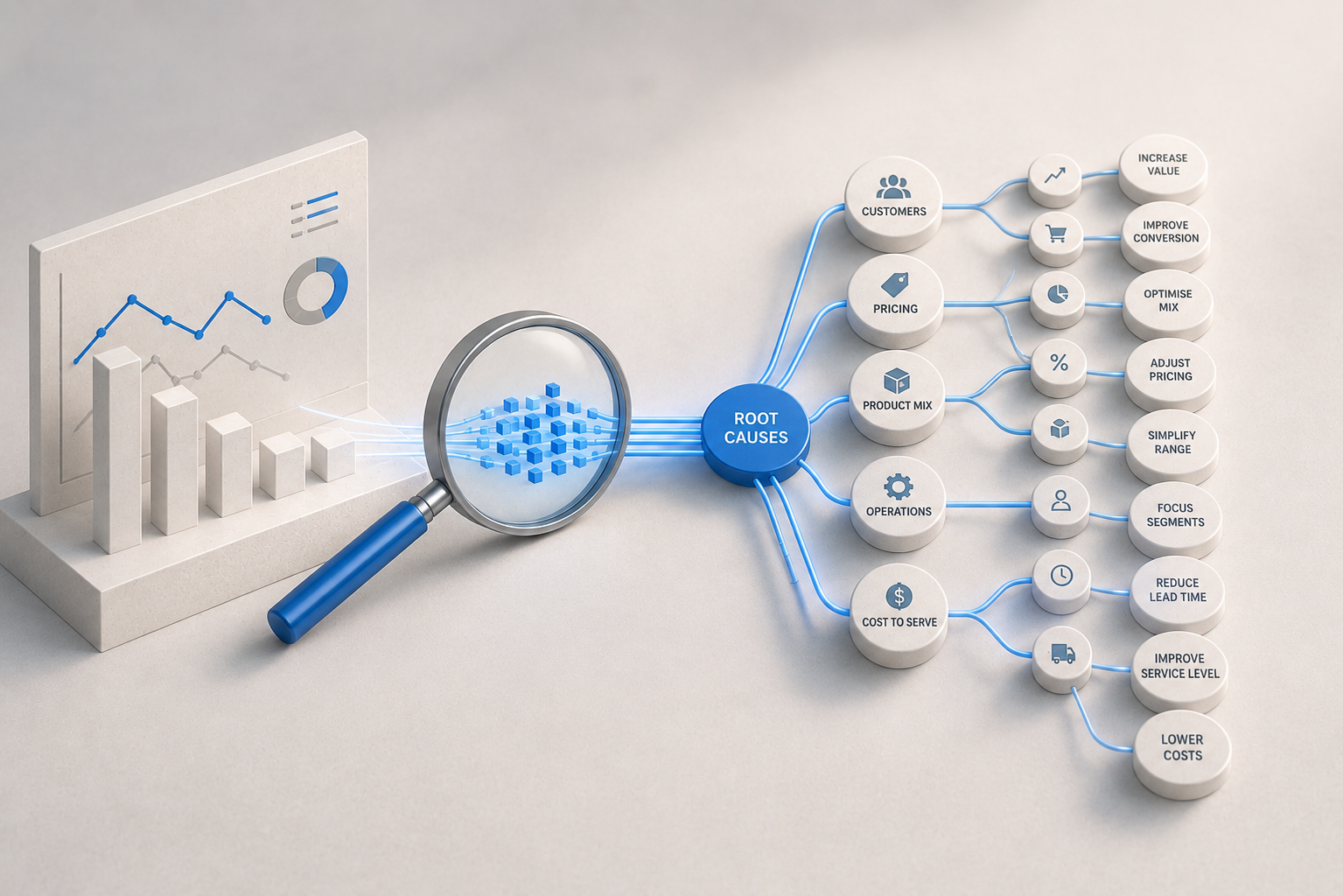
We think of this as integrated decision support: the ability to bring the relevant commercial, financial, operational and analytical perspectives together around a specific leadership choice, with enough depth to understand the consequences and enough clarity to act.
That does not require every function to become an expert in every other discipline. It requires a way to connect their strongest capabilities when the decision crosses their boundaries.
A subtle change in starting point can materially change the value of the work. Instead of beginning with the data, the system or the functional brief, begin with the decision leadership needs to make.
Instead of asking, “What does the dashboard show?” ask, “What does leadership need to decide?”
Instead of asking, “What can we analyse?” ask, “What do we need to understand to make that choice well?”
Instead of asking, “What does the forecast say?” ask, “Which assumptions are creating that outcome, and what happens if they change?”
Instead of asking, “Is this opportunity attractive?” ask, “How does it compare with the alternatives competing for the same resources?”
The analytical work is still important. So are the financial model, the market knowledge and the operational view. The difference is that each is now serving the same decision.
Enlite is deliberately positioned for decisions that sit across traditional functional boundaries. We combine analytics, extensive commercial finance experience, strategy formulation and operational understanding to help leadership teams see the decision as one connected commercial system rather than a collection of separate reports.
The form of the question changes from organisation to organisation, but the underlying need is often similar:
Our role is not to replace the capable teams or systems already present in the organisation. It is to work alongside them and help connect their information and expertise around the choice leadership is trying to make.
Consider a leadership team deciding how aggressively to pursue a new growth opportunity. The analytics team can see demand and customer behaviour. Sales believes the opportunity is significant. Finance has built a forecast. Operations understands the likely capacity requirements. Leadership has a strong strategic view.
Nothing is obviously missing. Yet the decision remains uncomfortable because the pieces have been developed separately. Demand has not been fully connected to customer economics. The forecast assumes a level of uptake that has not been tested against operational constraints. Capacity investment is being considered without a clear view of how quickly the opportunity needs to mature. The alternatives are plausible, but they are not being compared on the same commercial basis.
The value is not another analysis of one of those components. It is bringing the components together so leadership can see what needs to be true, where the economics are most attractive, what the constraints are, how the options differ and what evidence should govern the next step.
The organisation already had much of the answer. What it needed was a way to connect it.
How much value is already sitting inside the capabilities you have built?
This is the question we would encourage leadership teams to ask. Not whether the organisation has enough data or enough technology, but whether its strongest capabilities are creating all of the decision value they could.
If several of these questions resonate, the opportunity may be larger than adding another layer of reporting or technology. There may be considerably more value available from the capabilities you already own.
The existence of this gap does not automatically mean the answer is a major programme. A specific business decision can provide a far more practical place to test what becomes possible when the pieces are brought together properly.
That is why Enlite often begins with a focused Strategic Decision Pilot. Start with one real decision, work pragmatically with the information and capability already available, and determine whether a more integrated view materially changes the quality of the choice.
If it does, leadership has not only gained clarity on the immediate question. It has also seen the additional value its existing data, finance, technology and commercial capability can create when they're connected differently.
We know the feeling. Enlite was built for it.
We know what it feels like to have capable people, extensive information and increasingly powerful technology, yet still believe important decisions should be clearer than they are. Enlite was conceived to close that gap.
We do not exist to add another disconnected layer to the organisation. We help connect the capabilities already around the table with the commercial finance, strategy and analytical depth needed to create one clearer view of the decision ahead.
Because in many organisations, the next step-change in value may not come from adding another ingredient. It may come from finally connecting the ones you already have.
If there is a decision where you feel the organisation should already have a clearer answer, bring it to us. We would welcome the opportunity to understand the question and explore whether a focused Strategic Decision Pilot could help connect the missing pieces.

.svg)
.svg)